DARIEN, Ill. (Oct. 22, 2014) -- An Army Reserve Soldier was inducted in
the U.S. Army Marksmanship Unit Service Rifle hall of fame Saturday, for
his distinction and accomplishments as a rifle competition shooter.
"It's inexplicable what an honor it really is. There's not really
anything to compare it to," said Master Sgt. Norman Anderson, who is now
the head coach of the Army Reserve Service Rifle Team and an Army
Reserve careers counselor living in Knoxville, Tennessee.
Anderson has 22 total years in service in the Army. He spent his first
15 years on active duty with the U.S. Army Marksmanship Unit, or USAMU, a
team that trains its Soldiers to win competitions and enhances combat
readiness through train-the-trainer clinics, research and development.
The USAMU was formed in 1956 by President Dwight D. Eisenhower to raise
the standards of marksmanship throughout the U.S. Army. Members who earn
at least 50 points across their competitions become eligible for the
unit's Hall of Fame. The USAMU members have won hundreds of individual
and team National Championship titles, more than 40 World Championships
and 20 Olympic medals.
"Generally, the best memory (I have) is having fulfilled my desire to be
a member of the most dominant service rifle team in the United States,
to be around some of the greatest competitive marksmen and marksmanship
instructors, to put that kind of dynasty together, for that duration of
time. That's truly what made it all worth doing," said Anderson.
Anderson's first major victory was in 1997, at the inter-service
individual championship, when at the time he was the youngest Soldier to
win the match at the age of 23, and the first one to win it using the
M16 rifle. During the remaining time with the unit, he also won the
National Trophy Individual match, shot at Camp Perry, Ohio, in 2004, and
again in 2005. He also won the President's Hundred Rifle Trophy twice,
in 2005 and 2008. The first time he won the President's trophy, Gen.
Peter Schoomaker, who was the chief of staff of the Army at the time,
hand-delivered a letter to Anders signed by President George W. Bush.
"To shake hands with the chief of staff of the Army, that was pretty
cool. That certainly beats getting it in the mail," said Anderson, who
grew up in Kewanee, Illinois.
As a current coach and member of the Army Reserve Service Rifle Team,
Anderson continues to shoot among the best marksmen in the Army Reserve.
The team is one of three competition teams, plus another training team,
comprising the Army Reserve Marksmanship Program. The ARMP currently
operates under the 416th Theater Engineer Command, but is made up of
shooters and team members from across the Army Reserve.
Anderson said weapon marksmanship is essential to every Soldier, regardless of operational mission.
"The Army Reserve continues to fill the role of combat support, combat
and services support, and even in these capacities, Army Reservists are
being called upon daily to support the combat arms units, and that
support doesn't just come from beans and bullets and delivery of goods.
It comes from fire support, fire superiority, and that is attained
through weapon marksmanship," he said.
Anderson said shooting a rifle is as fundamental to the Army as reading, writing and arithmetic are vital to school student.
"There was a time in this country when if you couldn't shoot, you didn't
eat. I'm glad we don't live in those times anymore ... (but) just
because you can go to the grocery store and buy a steak, it doesn't mean
you shouldn't know how to shoot. There were people, generations before
us, who made this country what it is with their skills at arms," he
said.
Unfortunately, Anderson often sees marksmanship as a skill that is
undervalued and under-taught across the Army. Part of the reason is that
ammunition is expensive, and organizing a range is logistically
tedious. Units don't always have rifle experts within their own units
who can coach fellow Soldiers to the highest level. Too often Soldiers
are rushed through the range instead of making it into an enjoyable
experience that builds esprit de corps.
Anderson said he wishes the Army would put as much emphasis on marksmanship as it did on physical fitness.
"One more pushup might not save your life or the life of your buddy in a
combat environment, but one well-aimed shot might just be the one that
saves your whole entire unit," he said.
That's why earning recognition in this hall of fame category is so
meaningful to him. He hopes that his efforts - along with those of other
expert marksmen who have also been honored - have made a positive
impact on the Army and its Soldiers.
"I'd like to think that (we) have left our mark and have actually done
our very best to increase the proficiency of the Army with individual
assigned weapons ... We need to remember how important this skillset is
for the effectiveness of the Army and Soldier. We owe it to the Soldiers
to improve their marksmanship skills," he said.
http://www.army.mil/article/136571/Reserve_Soldier_inducted_in_Army_s_marksmanship_hall_of_fame/
By Sgt. 1st Class Michel Sauret
Thursday, October 23, 2014
Sky Soldiers parachute into Romania for rapid deployment exercise
GRAFENWOEHR TRAINING AREA, Germany (Oct. 22, 2014) -- Approximately 90
paratroopers from the 173rd Airborne Brigade's 1st Squadron, 91st
Cavalry Regiment conducted an airborne operation into Campia Turzi,
Romania, yesterday, to start the field portion of an Emergency
Deployment Readiness Exercise, referred to as an EDRE.
The exercise tests the paratroopers' ability to plan and execute full-spectrum operations on short notice as the U.S. Army Contingency Response Force in Europe. As such, the brigade provides ready troops to deploy within 18 hours, anywhere in the U.S. European, Africa or Central Command areas of responsibility.
Some 24 hours prior, instead of reporting to work for scheduled training, the squadron instead received notification from the brigade headquarters they would be deploying to Romania the next morning. The squadron then conducted mission analysis and began the orders process, drew necessary weapons and equipment, and headed to Grafenwoehr Army Airfield to don parachutes, conduct mission briefs and load the awaiting U.S. Air Force C-130 Hercules aircraft.
"We started with a warning order at [6 a.m.]," said Maj. Matthew Work, the brigade's executive officer, referring to the surprise notification. "This is part of building the readiness culture we have in the 173rd [Airborne Brigade], and building upon what we've been asked to do for U.S. Army Europe in expanding our EDRE capability."
After three hours in the air, approximately 900 kilometers east, the paratroopers jumped in all the equipment and supplies they would need for the next three days. From the drop zone, the paratroopers made linkup with Romanian troops on the ground, who played the role of host-nation forces in the scenario the paratroopers are operating in.
"These guys are thinking about once they leave the aircraft, what they have to do when they hit the ground to be able to assemble quickly and move out to their objective," said Sgt. Maj. Steven Campbell, the brigade's operations non-commissioned officer in charge. "It gets right at the heart of being ready to go at a moment's notice. Once they conduct the airborne assault, the commanders and leaders will be challenged because they'll be deprived of a lot of things -- sleep, food -- they're going to move long distances. The commander will have to take the intelligence he receives along the way and make critical decisions, which will drive where their unit goes."
As part of the EDRE, the brigade purposefully introduced stressors such as the uncertain environment, long foot movements and lack of sleep, all with an active opposing force in the area.
"Part of this EDRE is having our Soldiers being comfortable with the unknown," explained Work. "We are going to get our leaders and Soldiers to a point where they are tired and uncomfortable. They're going to deal with the unknown and cause people to think differently under stress and duress."
This is leader training all throughout, from the private all the way through the organization," added Work. "We have a number of scenarios that are set up to test leaders and help them think through problems. It's a phenomenal event that stresses the organization."
For the brigade, the execution of the drill is the culmination of months of effort, coordinating with the Romanian military and U.S. Embassy in Bucharest to provide tough, realistic training for the paratroopers.
"We've worked closely with our Romanian allies over the weeks leading up to this exercise," said Capt. David Dean, a brigade logistical planner who liaised with Romanian military forces in planning the exercise. Their professionalism and efforts in planning this event made this possible."
The EDRE is the first in a series of planned exercises over the next two months involving troops from the 173rd Airborne Brigade, alongside their NATO allies in Romania. The exercises are a part of Operation Atlantic Resolve, demonstrating U.S. commitment to NATO collective defense as well as building interoperability with allied forces.
Romania has been and continues to be a strong NATO ally," said Dean. "An exercise likes this demonstrates that and sets the stage for a series of future exercises to build on."
The EDRE comes just two weeks after the brigade finished its six-month deployment to Poland and the Baltic states of Estonia, Latvia and Lithuania. The "Sky Soldiers" of the 173rd Airborne Brigade transferred responsibility for that portion of the Atlantic Resolve mission to Soldiers from the U.S. Army's 1st Brigade Combat Team, 1st Cavalry Division.
"It's all about readiness," said Campbell. "They have to be ready. We don't know where we're going next, but we know we have to be ready at a moment's notice to answer the call."
http://www.army.mil/article/136632/Sky_Soldiers_parachute_into_Romania_for_rapid_deployment_exercise/
By Maj. Michael J Weisman, U.S. Army Europe
The exercise tests the paratroopers' ability to plan and execute full-spectrum operations on short notice as the U.S. Army Contingency Response Force in Europe. As such, the brigade provides ready troops to deploy within 18 hours, anywhere in the U.S. European, Africa or Central Command areas of responsibility.
Some 24 hours prior, instead of reporting to work for scheduled training, the squadron instead received notification from the brigade headquarters they would be deploying to Romania the next morning. The squadron then conducted mission analysis and began the orders process, drew necessary weapons and equipment, and headed to Grafenwoehr Army Airfield to don parachutes, conduct mission briefs and load the awaiting U.S. Air Force C-130 Hercules aircraft.
"We started with a warning order at [6 a.m.]," said Maj. Matthew Work, the brigade's executive officer, referring to the surprise notification. "This is part of building the readiness culture we have in the 173rd [Airborne Brigade], and building upon what we've been asked to do for U.S. Army Europe in expanding our EDRE capability."
After three hours in the air, approximately 900 kilometers east, the paratroopers jumped in all the equipment and supplies they would need for the next three days. From the drop zone, the paratroopers made linkup with Romanian troops on the ground, who played the role of host-nation forces in the scenario the paratroopers are operating in.
"These guys are thinking about once they leave the aircraft, what they have to do when they hit the ground to be able to assemble quickly and move out to their objective," said Sgt. Maj. Steven Campbell, the brigade's operations non-commissioned officer in charge. "It gets right at the heart of being ready to go at a moment's notice. Once they conduct the airborne assault, the commanders and leaders will be challenged because they'll be deprived of a lot of things -- sleep, food -- they're going to move long distances. The commander will have to take the intelligence he receives along the way and make critical decisions, which will drive where their unit goes."
As part of the EDRE, the brigade purposefully introduced stressors such as the uncertain environment, long foot movements and lack of sleep, all with an active opposing force in the area.
"Part of this EDRE is having our Soldiers being comfortable with the unknown," explained Work. "We are going to get our leaders and Soldiers to a point where they are tired and uncomfortable. They're going to deal with the unknown and cause people to think differently under stress and duress."
This is leader training all throughout, from the private all the way through the organization," added Work. "We have a number of scenarios that are set up to test leaders and help them think through problems. It's a phenomenal event that stresses the organization."
For the brigade, the execution of the drill is the culmination of months of effort, coordinating with the Romanian military and U.S. Embassy in Bucharest to provide tough, realistic training for the paratroopers.
"We've worked closely with our Romanian allies over the weeks leading up to this exercise," said Capt. David Dean, a brigade logistical planner who liaised with Romanian military forces in planning the exercise. Their professionalism and efforts in planning this event made this possible."
The EDRE is the first in a series of planned exercises over the next two months involving troops from the 173rd Airborne Brigade, alongside their NATO allies in Romania. The exercises are a part of Operation Atlantic Resolve, demonstrating U.S. commitment to NATO collective defense as well as building interoperability with allied forces.
Romania has been and continues to be a strong NATO ally," said Dean. "An exercise likes this demonstrates that and sets the stage for a series of future exercises to build on."
The EDRE comes just two weeks after the brigade finished its six-month deployment to Poland and the Baltic states of Estonia, Latvia and Lithuania. The "Sky Soldiers" of the 173rd Airborne Brigade transferred responsibility for that portion of the Atlantic Resolve mission to Soldiers from the U.S. Army's 1st Brigade Combat Team, 1st Cavalry Division.
"It's all about readiness," said Campbell. "They have to be ready. We don't know where we're going next, but we know we have to be ready at a moment's notice to answer the call."
http://www.army.mil/article/136632/Sky_Soldiers_parachute_into_Romania_for_rapid_deployment_exercise/
By Maj. Michael J Weisman, U.S. Army Europe
Wednesday, October 22, 2014
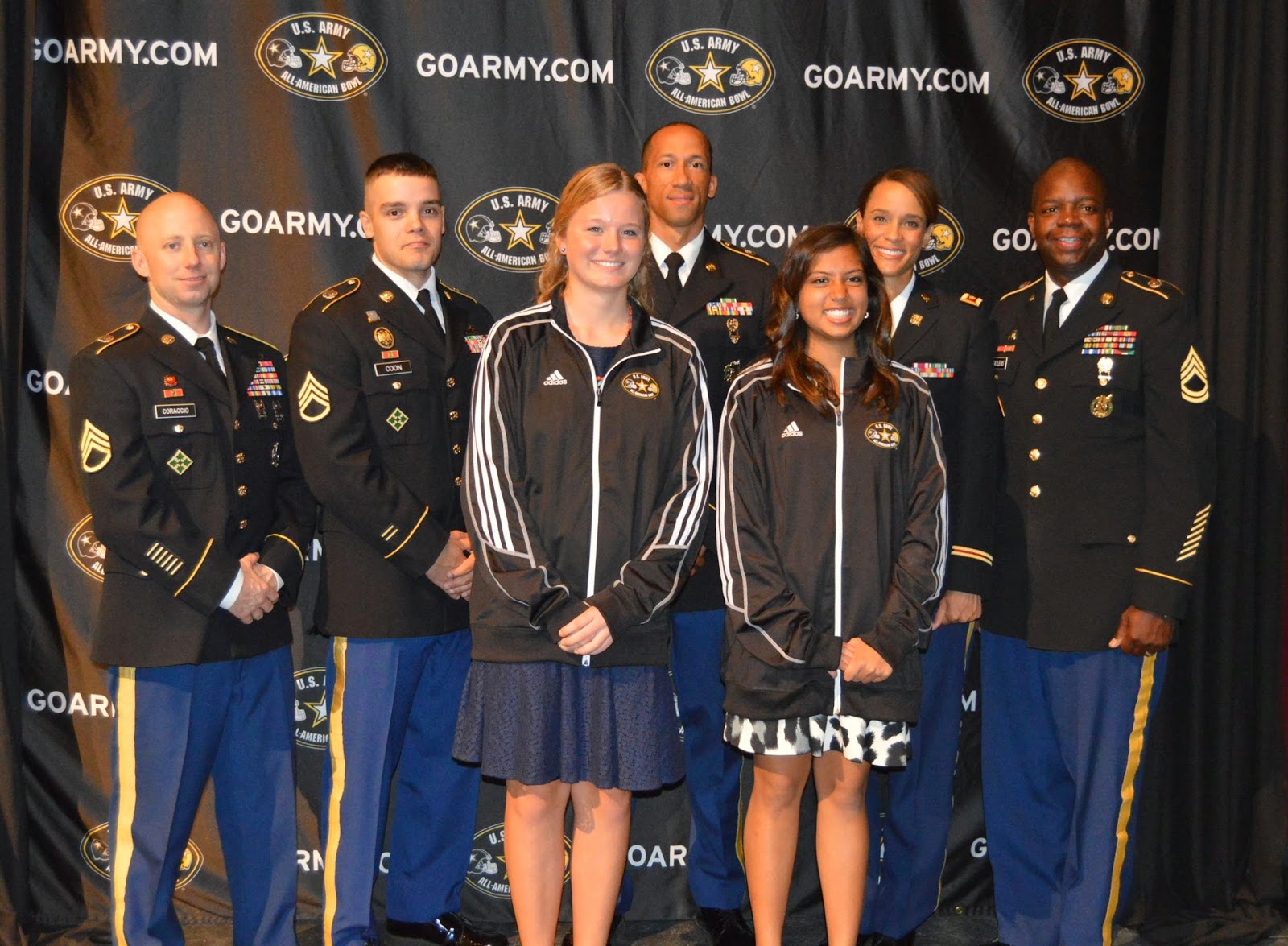
Olathe North band students selected to play in the All-American Bowl 2015
Today, two Olathe North band tudents were selected to play in
the All-American Bowl. Olathe band
members Carolyn Culp and Marisha Madhira, donned their Army jackets accepting
the honor to be a member of the All-American Band.
The U.S. Army All-American Marching Band has been a fixture at the U.S Army All-American Bowl since 2008. Selected by the National Association for Music Education in cooperation with All American Games and Drum Corps International, the band features the 125 top marching band members from across the United States.
Presenting the jackets are: SSG Coraggio, SSG Coon, SFC Smith, MAJ Carson, and SFC Gillen.
SFC Dubuque speaks to LULAC at the University of Kansas
Sgt. 1st Class Dubuque the Center Leader of the Army
Recruiting Center in Topeka briefed Army Reserve education benefits for the
League of United Latin American Citizens (LULAC) during the National Education
Service College Tour at the University of Kansas.
Tuesday, October 21, 2014
Millennial generation looking for options, look here
Millennial
generation looking for options, look here
My
name is Dean Somers, and I am one of the top employers in Kansas and
Missouri.
I
am glad the new school year is underway. During the last school year, I hired 767
high school graduates and 73 college degree holders. These 850 young people
committed to work for my department for anywhere from three to six years. They
are part of a small percentage of young Americans who qualify to be part of our
team.
My
employer offers full health care, tax-free allowances for living expenses, and
work locations around the world. There are 151 jobs available in 25 career
fields. We are continuously hiring, despite news coverage that makes people
think otherwise.
I
am a lieutenant colonel and the commander of the Kansas City U.S. Army
Recruiting Battalion.
The
Army continually needs new soldiers, just as most large-scale businesses need a
constant flow of entry-level employees.
The
vast majority of these 850 young men and women are starting their first
full-time job -- with competitive pay and benefits. If they leave the Army
without retiring, they will have tens of thousands of dollars to use for
college, the eligibility to buy a home with no down payment, and other benefits
due to U.S. veterans.
Because
the U.S. Army’s size changes based on the needs of the nation, the number of
new soldiers fluctuates year to year. What doesn’t fluctuate are the standards.
You
may have heard in the news recently that it’s tougher to join the Army than
ever before. The Army of the future requires highly qualified volunteers. Only
three in 10 young Americans fully meet our stringent qualifications.
Our
new soldiers will have a high school diploma. They will meet age-appropriate
height and weight standards. None will have engaged in serious criminal
misconduct. They will not have had a drug or alcohol dependency.
Our Kansas City Battalion
team makes the dreams come true for thousands who wish to serve their nation.
It’s true we take them away from their hometowns. But of all the 56,000 young
men and women whose initial term of Army service ended in 2013, 58 percent did
not re-enlist. Those still-young people come back with job experience and many
benefits, including guaranteed money for college. They come back prepared to be
productive members of your community.
We
thank the schools, coaches, mentors and, most all, the parents of those 850 new
soldiers. We ask them to provide encouragement for the next several hundred
qualified young people willing to stand up and honorably serve our country.
Lt.
Col. Somers is a 25-year Army veteran with a 2003 deployment to Iraq
and a 2013 deployment to Afghanistan. He
is a 1988 graduate of Florida Bible College (B.A.) and a 2006 graduate of
Webster University (M.A.).
The U.S. Army All-American Marching Band
The U.S. Army All-American Bowl is the nation’s premier high school
All-American game, featuring the best 90 players in a classic East vs.
West match-up every January in San Antonio’s Alamodome and broadcast
live on NBC. Last year’s U.S. Army All-American Bowl marked the 14th
anniversary of the game and drew a crowd of 40,017. The next Bowl game
will take place on January 3, 2015 at 1:00 PM Eastern, broadcast live
nationally on NBC and live across the world to soldiers deployed
overseas in the U.S. Army. Each year, the U.S. Army All-American Bowl
provides a glimpse into the future of college and pro football.
Joining the players in being honored as All-Americans and performing in the Alamodome will be the U.S. Army All-American Marching Band, comprising of 125 of the nation’s finest young marching band muscians who will perform during halftime.
http://www.usarmyallamericanbowl.com/about-aab/
Joining the players in being honored as All-Americans and performing in the Alamodome will be the U.S. Army All-American Marching Band, comprising of 125 of the nation’s finest young marching band muscians who will perform during halftime.
http://www.usarmyallamericanbowl.com/about-aab/
Warrant Officer Candidate School
Those interested in becoming Warrant Officers must be selected for
Warrant Officer Candidate School (WOCS), which is generally held in Fort
Rucker, Alabama. Technical specialty applicants must be Staff
Sergeant/E-6 or higher to be considered for selection. There is no
minimum grade requirement for aviation applicants.
The school is designed to assess candidates’ potential for appointment as Warrant Officers and prepare them for service in 16 of the Army’s 17 branches (the Special Operations branch trains and appoints its own Warrant Officers). The course also focuses on training similar to Officer Candidates School (OCS), and provides candidates a foundation of leadership skills that will eventually help them manage others.
After a candidate completes WOCS, he or she is appointed as a Warrant Officer (WO1). Graduates are then sent to their specific U.S. Army branches, where they receive more focused technical training in their specialties.
http://www.goarmy.com/careers-and-jobs/current-and-prior-service/advance-your-career/warrant-officer.html
The school is designed to assess candidates’ potential for appointment as Warrant Officers and prepare them for service in 16 of the Army’s 17 branches (the Special Operations branch trains and appoints its own Warrant Officers). The course also focuses on training similar to Officer Candidates School (OCS), and provides candidates a foundation of leadership skills that will eventually help them manage others.
After a candidate completes WOCS, he or she is appointed as a Warrant Officer (WO1). Graduates are then sent to their specific U.S. Army branches, where they receive more focused technical training in their specialties.
http://www.goarmy.com/careers-and-jobs/current-and-prior-service/advance-your-career/warrant-officer.html
Subscribe to:
Posts (Atom)